
Supervised machine learning regression predicts a continuous target variable from input features. This guide walks you through the core concepts, popular algorithms, and a hands‑on Python workflow you can start today. By the end you’ll have a working model and know how to iterate for better results.
What is regression?
Regression is a type of supervised learning where the goal is to estimate a numeric value — like house price, sales forecast, or temperature — based on historical data. Unlike classification, which outputs a category, regression outputs a real number. The training data consists of feature columns (independent variables) and a target column (dependent variable). The model learns the relationship so it can predict the target for new, unseen feature sets.
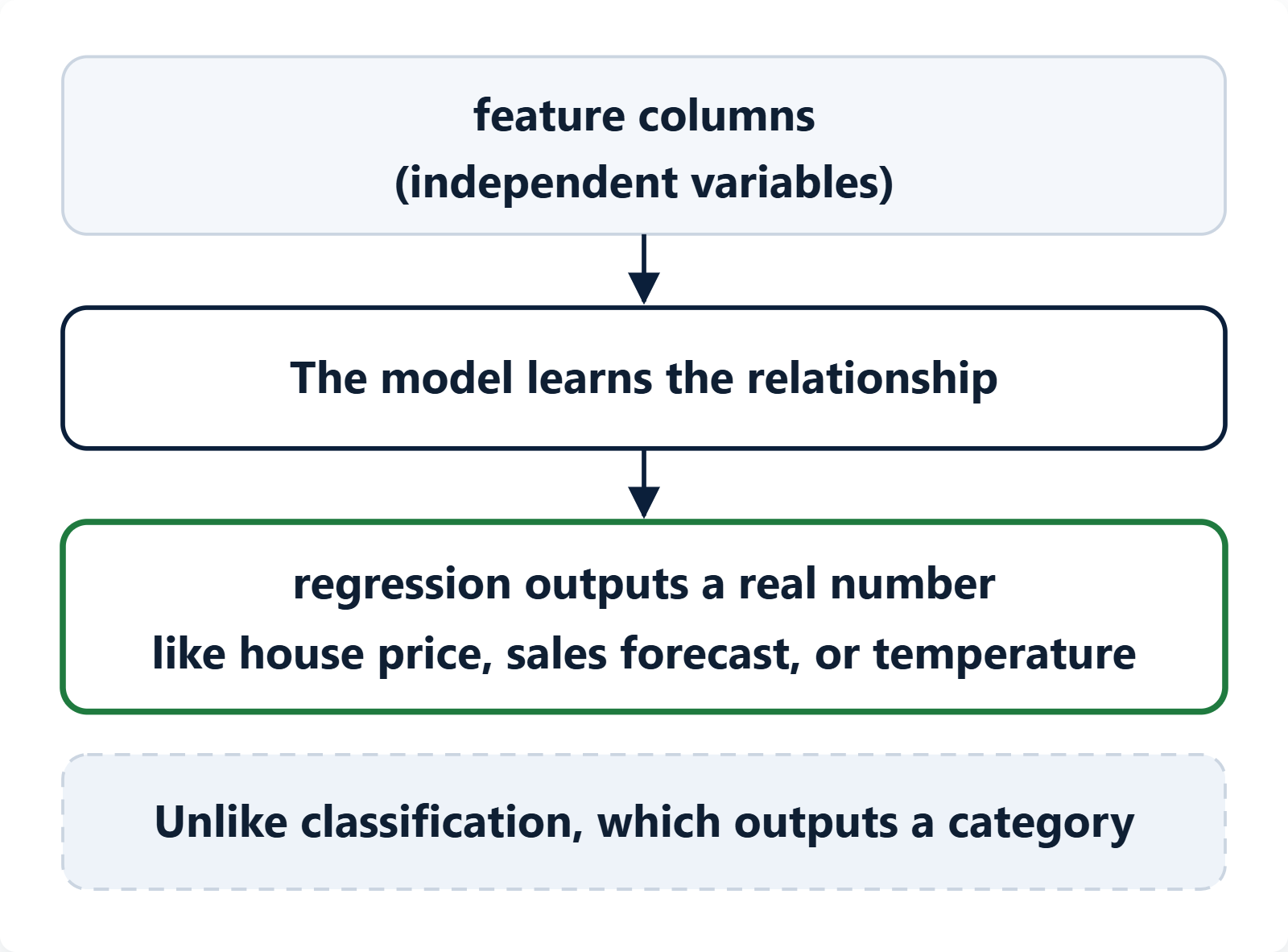 Regression turns feature columns into a real number, not a category.
Common regression algorithms
Choosing the right algorithm depends on data size, linearity, and interpretability needs. Here are the most widely used ones:
- Linear Regression – assumes a straight‑line relationship; fast, easy to interpret.
- Ridge & Lasso Regression – add regularisation to handle multicollinearity and perform feature selection.
- Decision Tree Regressor – captures non‑linear patterns; prone to over‑fitting if not pruned.
- Random Forest Regressor – ensembles many trees for better generalisation.
- Gradient Boosting Regressors (XGBoost, LightGBM, CatBoost) – state‑of‑the‑art for tabular data, often winning competitions.
- Support Vector Regression (SVR) – works well with small‑to‑medium datasets and non‑linear kernels.
Read the full article on NerdIT: https://nerdit.in/blog/supervised-machine-learning-regression-algorithms-with-python-a-practical-how-to?utm_source=blogger&utm_medium=excerpt&utm_campaign=supervised-machine-learning-regression-algorithms-with-python-a-practical-how-to
